

Waqf means stopping or pausing during Quran recitation. Knowing where to stop, where to continue, and where stopping is forbidden is not optional; stopping at the wrong point can completely change the meaning of a verse.
In Surah Al-Muzzammil (73:4), Allah SWT commands measured recitation. Part of that measured recitation is respecting the stopping points placed throughout the Quran. These symbols are called Waqf signs, and every student of Quran recitation needs to understand them.
Why Waqf Matters, A Real Example
A common mistake beginners make is stopping after “وَاللَّهُ يَعْصِمُكَ” in Surah Al-Ma’idah (5:67). Stopping there makes it sound like the sentence ends with “Allah will protect you” — but the verse continues with “مِنَ النَّاسِ” meaning “from the people.” The full meaning, that Allah will protect the Prophet ﷺ from people, is lost entirely with a wrong stop.
This is why in our Quran recitation course, we introduce Waqf signs gradually as a student’s reading improves, ensuring they understand the reason behind each symbol before applying it.
The Main Waqf Stop Signs Explained
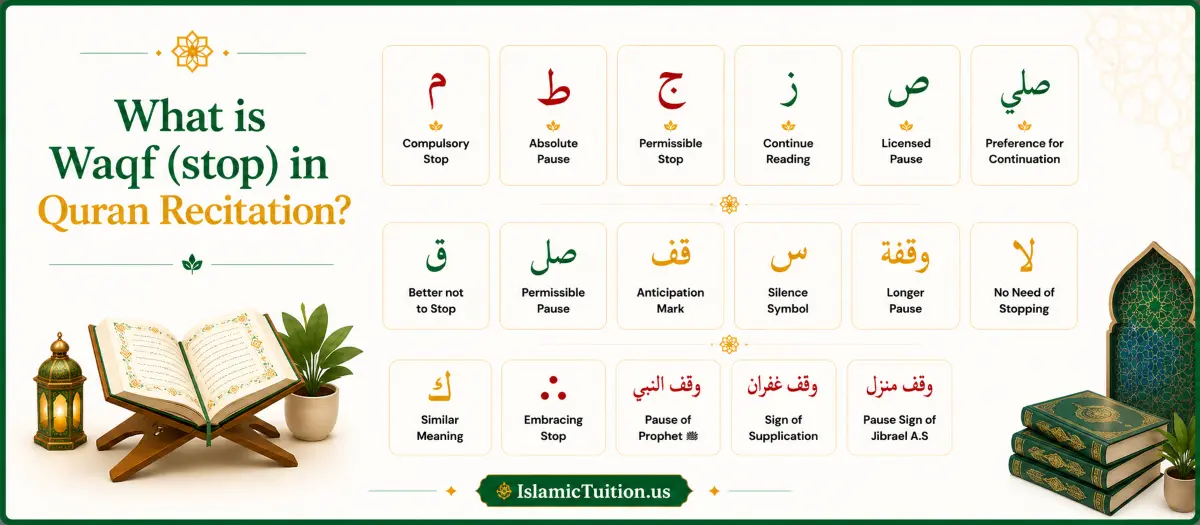
The list explaining each type of Sign/symbol used for Waqf in the Quran reading.
◯: End of Verse (Waqf e Taam)
A circle marks the end of a Quranic verse. This is a complete stop. The meaning of that verse is fully delivered, and the reciter pauses before continuing to the next.
م: Compulsory Stop (Waqf e Laazim)
The letter Meem indicates a mandatory pause. Not stopping here changes the meaning of the verse significantly. This is among the most important signs for beginners to learn early.
ط: Absolute Pause (Waqf e Mutlaq)
Stopping here is strongly recommended. The meaning of what came before is complete and a pause helps the reciter absorb it fully before continuing.
ج: Permissible Stop (Waqf e Jaaiz)
Stopping is allowed but not required. The matter in that part of the verse is complete, though the reciter may continue without stopping.
ز: Continue Reading (Waqf e Mujawwaz)
Continuing without stopping is preferred here, though stopping is not prohibited.
ص: Licensed Pause (Waqf e Murakh-khas)
A pause is permitted only if the reciter needs to catch their breath. Continuing without stopping is better.
صلى: Preference for Continuation (Al-Wasl Awlaa)
Continuing without a stop is clearly preferred here.
لا: Do Not Stop (Laa)
This is the sign beginners find most confusing. It means stopping here would change or break the meaning of the verse. The reciter must continue — unless this sign appears at the very end of a verse alongside the circle mark, in which case stopping is acceptable.
س: Brief Silence (Saktah)
A very short pause without breaking breath. The reciter pauses momentarily without taking a new breath before continuing.
وقفة: Longer Pause (Waqfah)
Similar to Saktah but slightly longer, still without breaking the breath.
∴: Embracing Stop (Mu’aanaqah)
This sign appears at two points within the same verse. The reciter stops at one of the two points only — not both.
ق: Better Not to Stop (Qeela Alayhil-Waqf)
Scholarly opinions differ on stopping here. Continuing is generally preferred.
قف: Anticipation Mark (Qif)
Placed where a reader might expect no stop sign is needed, reminding the reciter to pause.
وقف النبي: Pause of the Prophet ﷺ
Marks a place where the Prophet Muhammad ﷺ himself paused during recitation. Following this stop is considered Sunnah.
When Are Waqf Signs Taught
From the beginning, students focus on reading letters, vowels, and basic fluency. Waqf signs are introduced gradually as recitation improves. Introducing all symbols too early can overwhelm a new student.
As students develop through our Quran recitation classes, Waqf knowledge builds naturally alongside Tajweed rules. Understanding both together — as covered in our Tajweed course — gives students the complete picture of correct, measured recitation.
For a deeper understanding of how Tarteel and Waqf connect, our post on what is Tarteel in Quran recitation covers this relationship in detail.
Frequently Asked Questions
The Laa (لا) sign is the most commonly misread. Students instinctively pause where the text feels like a natural break, but the Laa sign means stopping there changes the meaning. Learning this early prevents a very common and significant recitation error.
Yes. Incorrect stops in Al-Fatiha or any Surah recited in Salah can alter the meaning. Scholars recommend learning correct stopping points as part of proper Quran recitation training rather than treating it as an advanced topic.
There are approximately 15 to 16 recognised Waqf symbols used across different Quran editions. The most common ones a student encounters regularly are the end-of-verse circle, Meem (compulsory stop), Laa (do not stop), and Saktah (brief silence without breaking breath).