

Tarteel means reciting the Quran in a slow, measured, and rhythmic way, giving every letter its correct sound, every vowel its proper length, and every pause its right place.
Allah SWT commands it directly in the Quran:
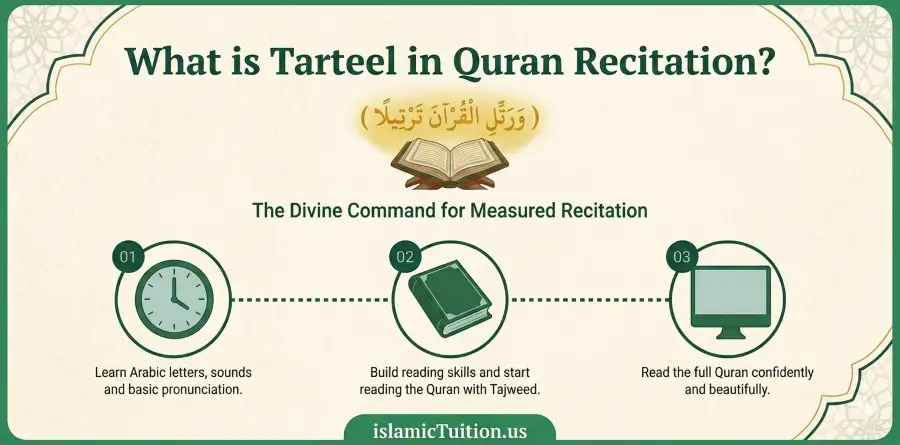
وَرَتِّلِ الْقُرْآنَ تَرْتِيلًا “And recite the Quran with measured recitation.” (Surah Al-Muzzammil, 73:4)
This is not a recommendation. It is a divine instruction. And understanding that is usually the moment students take their recitation seriously in a completely different way.
What Tarteel Actually Means in Practice
The word Tarteel comes from the Arabic root Rattala, which implies arrangement, clarity, and deliberate flow. In the context of Quran recitation, it means:
- Pronouncing each letter clearly from its correct articulation point (Makhraj)
- Giving short vowels their brief, crisp sound and long vowels their full elongation
- Pausing at the correct stopping points (Waqf)
- Maintaining a calm, unhurried pace that allows the words to be heard and reflected upon
It does not mean reading so slowly that the recitation loses its natural flow. The best description is steady and deliberate — not rushed, not dragged.
Scholars of Tajweed, including Ibn Al-Jazari, one of the most recognised authorities on Quranic recitation, described Tarteel as the proper application of Tajweed rules with awareness and presence. It is the standard by which the Prophet Muhammad ﷺ recited and taught his companions.
Is Tarteel the Same as Tajweed?
They are closely related but not the same thing.
Tajweed refers to the set of rules governing correct pronunciation, where each letter comes from, how vowels are applied, when to make Ghunnah, and how long to stretch a Madd. These are the technical rules.
Tarteel is the quality of recitation that results from applying those rules with the right pace, clarity, and intention. You can know every Tajweed rule and still rush through your recitation. Tarteel is what turns technical correctness into something meaningful.
Think of Tajweed as knowing the rules of a language and Tarteel as speaking it with clarity and care.
When Is Tarteel Taught
From the very first Quran lesson, the idea of reading slowly and carefully is introduced. We do not ask a beginner to think about Tarteel as a concept immediately; the early focus is on letter recognition, vowel sounds, and basic fluency.
But as a student’s reading stabilises and letter pronunciation becomes more natural, their attention shifts to how they are reading. Are they rushing through words to reach the end of the line? Are they giving each Madd letter its proper length? Are they pausing where the Quran indicates they should stop?
That gradual shift from reading the Quran to reciting it properly is where Tarteel becomes the focus. It is a natural progression rather than a separate lesson introduced at a fixed point.
Why the Quranic Command Changes How Students Approach It
When students understand that Tarteel is not a teacher’s preference but a direct Quranic instruction, something shifts in how they approach their recitation.
Many students, especially adults, have been reading the Quran quickly for years, covering pages in Ramadan, finishing Juzz as fast as possible. When they realise that Allah SWT specifically instructed measured, deliberate recitation, the instinct to rush starts to feel like something worth correcting rather than a harmless habit.
In our experience, this awareness motivates students in a way that technical correction alone does not. Knowing the why behind a rule makes the effort to apply it feel meaningful rather than mechanical.
How to Recite the Quran with Tarteel
Applying Tarteel in practice comes down to a few consistent habits:
Read at a pace where every word is clear. If someone listening cannot distinguish your letters, you are moving too fast.
Give each vowel its correct length. Short vowels should be brief and crisp. Long vowels produced by Alif, Waw, and Yaa should be stretched for their proper duration, not cut short and not overdragged.
Pause at Waqf signs. The Quran contains stopping symbols indicating where to pause, where stopping is preferred, and where you must not stop mid-meaning. Following these is part of measured recitation.
Stay present. Tarteel is connected to Tadabbur, reflection on the meaning of what is being recited. Reading with awareness rather than autopilot is part of what distinguishes Tarteel from simply reading words aloud.
Working through these habits is a central part of our Quran recitation course, where tutors listen to every session and guide students toward this standard gradually and practically.
Frequently Asked Questions
Recite slowly and clearly, giving each letter its proper pronunciation, each vowel its correct length, and pausing where appropriate while applying Tajweed correctly.
Recite the Quran slowly and clearly, giving each letter its proper pronunciation, correct vowel length, and proper pauses. Tarteel is reciting with Tajweed in a calm and measured way. If you want to study with a qualified Quran teacher, check our Quran Recitation Course.
In short:
Tajweed is the rules of correct Quran pronunciation.
Tarteel is reciting the Quran clearly, slowly, and properly using those rules.
Yes. Beginners can learn Tarteel from the start by reciting slowly and clearly with proper guidance. As Tajweed and fluency improve, Tarteel develops naturally. Starting with a strong foundation through a Noorani Qaida course makes correct recitation easier from the beginning.