

Your role in your child’s Hifz journey is not to teach; it is to support, encourage, and keep consistency alive between sessions.
What happens at home between classes is often what determines how fast a child progresses. Here is exactly what works.
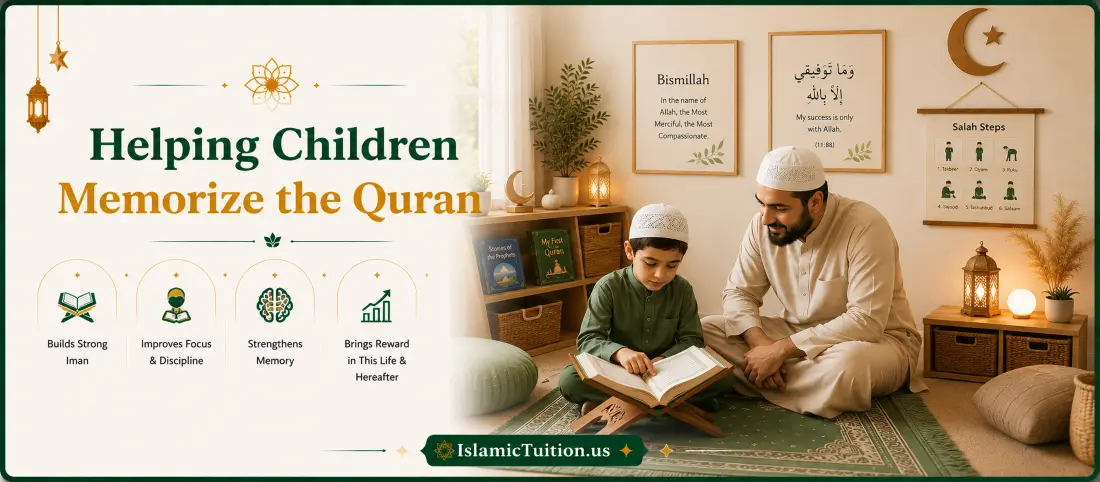
Build Their Daily Routine to memorize Quran at home
The most effective thing parents can do is make Quran memorization a fixed part of their child’s daily routine, not something that happens when time allows.
After Maghrib works well for most families. School is done, the house settles, and the timing connects naturally to Islamic practice. Even 15 to 20 minutes of daily revision is enough. The goal is habit, not hours.
When memorization becomes as automatic as brushing teeth, progress becomes consistent and far less dependent on motivation levels.
How to Listen to Their Lesson Each Evening
When your child comes home after Hifz class, ask them to recite their new lesson to you. This does two things: it reinforces what they memorized, and it shows the child that their progress matters to you.
When they recite, appreciate them first. Even if there are mistakes, start with encouragement. Then gently point out any errors. A child who feels proud of what they recited will come back to it again tomorrow. A child who only hears correction often starts avoiding it.
You do not need to know the Quran yourself to do this. Your attention and reaction are what matter most at this stage.
Never Push or Force – This Is Non-Negotiable
At Islamic Tuition, we train our tutors strictly on this and give the same guidance to every parent, never force a child during Hifz.
Pushing too hard for fast progress is one of the most common mistakes. When a child feels pressured to memorize faster than they naturally can, their confidence drops, they start associating the Quran with stress, and in some cases, they refuse to continue entirely. Recovering that motivation takes far longer than the time gained by pushing.
Progress in Hifz is gradual by design. Trust the process, celebrate small wins, and let the tutor guide the pace.
What If You Cannot Verify Their Recitation?
Many parents are not Huffaz themselves and feel unable to check if their child is reciting correctly. This is more common than most parents admit, and it is not a barrier.
Two practical options:
Ask the tutor directly. After each session, ask for a brief note on what was covered and what needs revision at home. Our Quran tutors at Islamic Tuition send this via WhatsApp, so parents always know what to focus on.
Use a Quran recitation app or YouTube. Ask your child to listen to a qualified Qari, Sheikh Mishary Rashid Al-Afasy or Sheikh Abdul Rahman Al-Sudais, on a Quran app, reciting the same verses they memorized. Your child can compare their own recitation to the Qari’s and notice differences themselves. This builds self-correction, which is a valuable skill in its own right.
Create a Memorization-Friendly Environment at Home
A small dedicated space makes a genuine difference. A corner with a Quran stand, prayer mat, and a simple Arabic alphabet or Dua chart on the wall signals to your child that this space is for learning, separate from where they play or watch screens.
Children are highly responsive to their environment. A calm, Islamically themed corner gives them a physical cue to focus and creates a positive association with their Hifz practice over time.
Frequently Asked Questions
15 to 20 minutes of focused daily revision is enough to help children memorize the Quran. Consistency beats length every time.
Yes, completely normal. Daily revision of old lessons alongside new ones prevents this. Ask your tutor to structure sessions with Sabaq (new lesson) and Manzil (older revision) together during the online Quran classes.
Never force kids to learn the Quran. Keep sessions short, keep the environment positive, and discuss with their tutor. Sometimes a different tutor or teaching approach resolves resistance better than pressure does. Learn more in our guide on how to teach your child to read the Quran at home.