

Most people who have been reading the Quran for years are still making Tajweed mistakes without realizing it. That is not their fault. Nobody told them the rules clearly.
Tajweed literally means to beautify and adorn. In the context of Quran recitation, it means pronouncing each letter correctly from its exact point of articulation and applying the rules of recitation the way the Quran was revealed. A slight mispronunciation in Arabic can completely change the meaning of a word. The word Qalb means heart. Pronounce the Qaaf incorrectly as a Kaaf, and it becomes Kalb, which means dog in Arabic.
For the last 6 years, teaching students of all levels, one pattern I have seen consistently is that beginners who learn Tajweed from the start make far fewer errors than those who try to correct habits built over years of reading without rules.
This guide covers the core rules every beginner needs to know.
Where It All Starts: Makharij
Before any rule, you need to know where each Arabic letter comes from. Makharij means the articulation points, the exact place in your mouth or throat where each letter is produced.
Arabic letters come from five main areas:
- The throat – letters like Hamza, Haa, Ain, Ha, Ghain, Kha
- The tongue – the largest group, with different positions for different letters
- The lips – letters like Ba, Meem, Waw, Fa
- The nose – for nasal sounds like Ghunnah
- The space of the mouth and throat, for the long vowel sounds
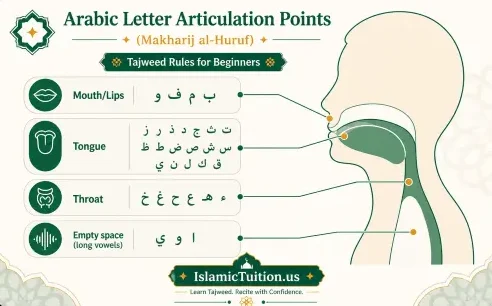
This forms the foundation of Tajweed. When I begin teaching a new student, whether a child or an adult, we always start with the beginner Qaida. If a letter is not pronounced from its correct articulation point, every rule that follows will be affected.
The Main Tajweed Rules Explained Simply
1. Ghunnah (Nasal Sound)
Whenever the letter Noon or Meem has a Tashdeed (a tiny W-type sign), make a nasal humming sound through the nose for about two seconds. Think of it as holding the sound in your nose briefly before moving to the next letter.
In our classes, students learn to recognise Ghunnah letters through a colour-coded Quran. Red marking indicates where Ghunnah is required. Once a student understands what the colour means, they begin applying the rule automatically during reading.
2. The Four Rules of Noon Saakin and Tanween
When a Noon has a sukoon (no vowel) or when you see Tanween (double vowel marks), one of four things happens depending on the letter that follows:
- Izhaar: Read the Noon clearly without any nasal sound. This applies when one of six throat letters follows (Hamza, Haa, Ain, Ha, Ghain, Kha)
- Idghaam: Merge the Noon into the next letter and make Ghunnah. Applies with Yaa, Noon, Meem, Waw (and without Ghunnah for Raa and Laam)
- Ikhfaa: hide the Noon with a partial nasal sound. Applies with 15 letters, including Ta, Tha, Jeem, Dal and others (check the above image to know all the letters)
- Iqlab (Qalb): when Ba follows Noon Saakin or Tanween, change the Noon into a Meem sound and make Ghunnah
These four rules cover almost every situation involving Noon in the Quran. Students who struggle with these the most are usually those who were never taught they existed.
3. Rules of Meem Saakin
When Meem has a sukoon, three rules apply based on what follows:
- If another Meem follows, merge them and make Ghunnah (Idghaam)
- If Ba follows, hide the Meem with a light nasal sound (Ikhfaa)
- If any other letter follows, read the Meem clearly without Ghunnah (Izhaar)
4. Qalqalah (Echoing Sound)
Five letters produce an echoing or bouncing sound when they carry a sukoon or appear at the end of a verse. The five are: Qaaf, Tuaa, Ba, Jeem, Dal, often remembered through the phrase Qutb Jad.
In a colour-coded Quran, these letters are marked in blue. When a student sees a blue letter with a jazam, they know to produce that slight echo. Even when stopping on a verse that does not have a jazam, if the last letter is one of these five, Qalqalah still applies.
5. Madd (Lengthening)
Madd means to stretch or pull a vowel sound. There are two types to know at the beginner level:
- Short Madd: Stretch the vowel sound for two seconds. This occurs naturally with the three vowel letters (Alif, Waw, Yaa)
- Long Madd: Stretch the letter about 4-5 seconds. This happens when a Madd letter is followed by a Hamza or a sukoon in specific positions
In the colour-coded Quran, Madd letters are visually identifiable, and students learn to stretch them correctly before understanding the technical reason behind each type.
6. Full Mouth Letters (Tafkheem)
Seven letters are always read with a full, heavy mouth, making them bold while reading: Khaa, Saad, Daad, Ghain, Tuaa, Qaaf, Dhaad, remembered as Khuss Dhaghit Qidh. In a colour-coded Quran, these appear in green.
These contrast with the light mouth letters that are read with a thinner, lighter sound. Getting this distinction right is one of the biggest differences between a heavy and a refined recitation.
7. Waqf: Rules for Stopping
Knowing where and how to stop in the Quran is a separate science. The key basic rules:
- When stopping, remove the vowel from the last letter and replace it with a sukoon
- If the last letter has Tanween with two fathas, read the final vowel as a stretched Alif
- If the last letter is a round Tuaa (taa marboota), change it to a soft Haa when stopping
- Specific symbols in the Quran indicate whether stopping is compulsory, preferred, or optional
How We Teach Tajweed
We start students on a colour-coded Tajweed Quran. Green shows full mouth letters, red marks Ghunnah, and blue identifies Qalqalah letters. Students apply the visual cues first without needing to know the technical name for each rule.
As their reading improves, the tutor introduces the reason behind each colour, what the rule is, why it applies, and where in the Quran to look for it. For more advanced students, we also use a structured reference booklet covering Idghaam, the rules of Raa and Laam, and the detailed Waqf symbols.
Every session is screen-shared, so the student sees the exact Quran page the tutor is reading from. Where needed, tutors explain rules visually using a digital whiteboard during the class.
The goal is not just to know the rules but to make them a natural part of how you recite, until you do not need to think about them at all.
If you want to start learning Tajweed with a structured approach from the beginning, our Tajweed course covers all of this progressively, starting from wherever you currently are in your Quran reading. If you are not yet reading fluently, the Quran Recitation course is the right starting point.