

If you are enrolling your child or starting yourself, this question comes up almost every time. Both involve Arabic. Both lead to reading the Quran. So what exactly is the difference, and which one do you need?
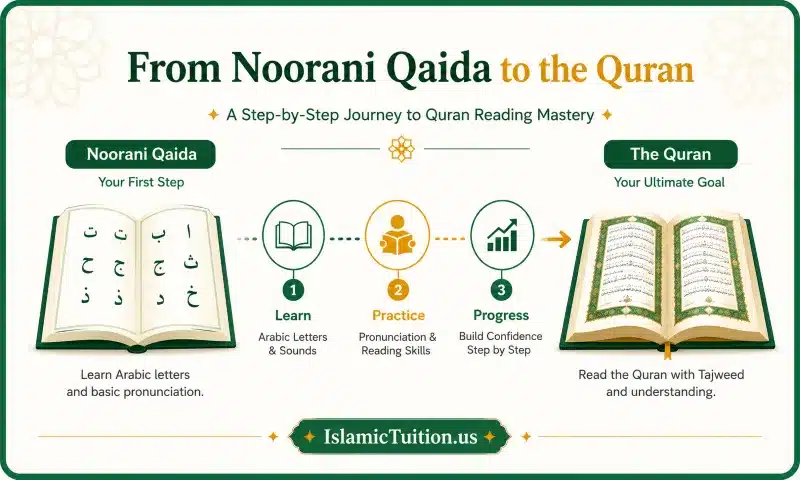
What Noorani Qaida Actually Is
Qaida is a beginner’s learning book designed for someone who has never seen Arabic before. It builds the foundation step by step, Arabic alphabet recognition, vowel sounds like Fatha, Kasra, and Damma, letter joining, Sukoon, Shaddah, and how all of these combine to form readable Arabic words.
Think of it this way. Before a child reads an English book, they learn letters, then sounds, then how letters join to make words. Qaida does the same thing for Arabic. Without it, a student looking at the Quranic text sees a collection of unfamiliar shapes with no way to decode them.
Our Noorani Qaida course covers 26 lessons built specifically for English-speaking beginners. Each lesson builds directly on the previous one, and nothing is introduced before the student is ready for it.
What Quran Reading Is
Quran reading is the next step. It is for students who already understand the Arabic alphabet, vowel signs, and basic letter joining and are now ready to apply that knowledge to actual Quranic text.
The Quran uses the same letters and signs a student learns in Qaida, but now they appear across 604 pages of connected text with varying word lengths, Tajweed markings, and stopping signs. Quran reading classes take that foundation and develop it into fluent, accurate recitation over time.
Can You Skip Qaida and Go Straight to Quran Reading?
It depends on what you already know.
If a student comes and says they have already completed Qaida elsewhere and want to start Quran reading, we start from the Quran. We may spend a few minutes in the first sessions revisiting specific Qaida concepts if gaps appear, but we do not take the student back to the beginning.
If someone has done half of Qaida and learned the alphabet along with basic signs like Fatha, Kasra, Sukoon, and Shaddah, we often try them on simple Quranic text alongside the remaining Qaida lessons. Both together, rather than one strictly before the other.
What we do not recommend is jumping straight into Quran reading with zero Qaida background. Students who do this almost always have the same issues: letters that look similar get confused, vowel sounds are guessed rather than read, and reading stays broken and slow for much longer than it would have with a proper foundation.
How Long Before Quran Reading Feels Natural
After completing Qaida and starting the Quran, most students go through an adjustment period. The letters are familiar, but seeing them in longer connected words across a full page is a different experience from the short practice lines in Qaida.
In general, after reading through 1 to 2 Juzz, students start to feel more comfortable. Word patterns repeat across the Quran, so the more a student reads, the more familiar the combinations become. Reading speed and confidence grow together over that period.
The Simple Way to Think About It
Qaida is the preparation. Quran reading is the application.
One without the other creates problems. Qaida, without ever moving to the Quran, means the skill never gets used in its real context. Quran reading without Qaida means building on a foundation that is not there.
If you are unsure where you or your child currently stand, the best way to find out is a real assessment with a qualified tutor. Our 5-day free trial starts with exactly that: the tutor checks the student’s current level in the first session and recommends the right starting point, whether that is Qaida, Quran reading, or a combination of both.
Frequently Asked Questions
Not necessarily. We assess their current level in the trial class. If their Qaida foundation is solid, we move straight to Quran reading. If there are specific gaps, we revisit only those areas before progressing.
If they can read connected Arabic text with correct vowel sounds, yes. If they know the alphabet but struggle with joining letters or applying vowel signs accurately, a short Qaida revision is worth doing before moving to the Quran.
When they can read any new line of Qaida text independently without help from the tutor, they are ready. The ability to read unfamiliar text, not just memorised lines, is the clearest sign.