

One of the most common questions Muslim parents ask before enrolling their child is: ” Is my child old enough to start?
The honest answer is that age alone is not the only thing that matters. Readiness, attention span, and the right teaching approach all play a role. But based on working with students as young as 4 and as old as 60, there are clear patterns worth knowing before you make that decision.
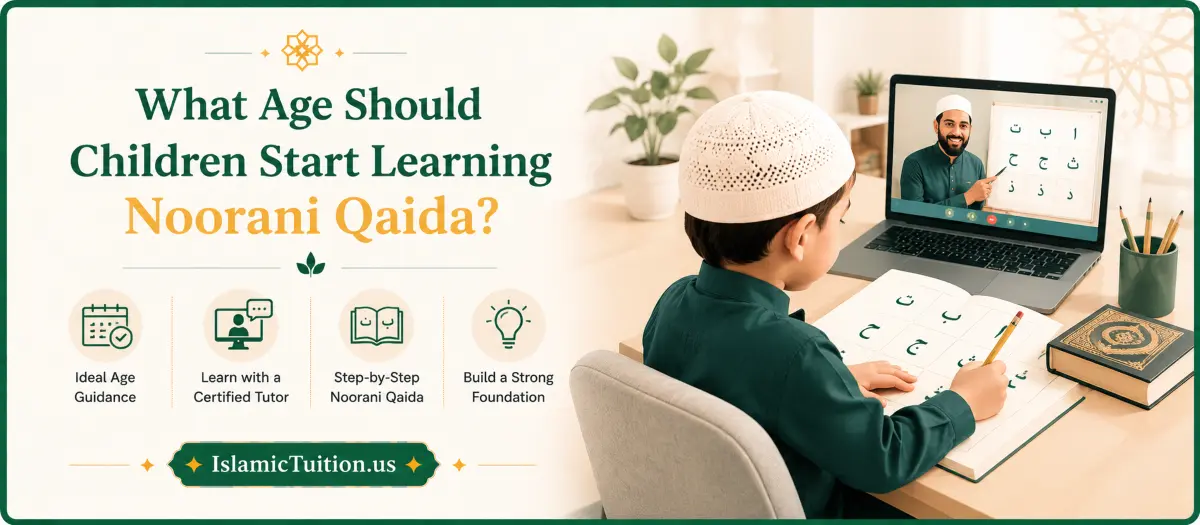
The Ideal Age: 5 to 10 Years
From observation working with students since 2020, the age range of 5 to 10 years is where children tend to pick up Noorani Qaida the fastest. Their memory is sharp, they adapt quickly to new sounds, and with the right tutor, learning Arabic letters becomes something they genuinely enjoy rather than something they resist.
Research from the American Academy of Pediatrics supports this broadly; children in early and middle childhood are in a critical window for language acquisition and phonological awareness, making it easier to learn new letter sounds and connect them to spoken patterns.
That said, starting at 5 is not a strict rule. Some children are ready earlier. Others need a little more time.
What About 4-Year-Olds?
This one depends entirely on the individual child.
During Ramadan this year, one family joined with three children aged 3, 4, and 5 for trial classes. After more than a month, both the family and our team agreed it was best to continue only with the 5-year-old. The younger two were simply not at the stage where sitting through a structured class was comfortable for them. The plan is to re-enroll them in 6 to 8 months.
At the same time, another family has had their 4-year-old daughter, Aliza, learning with us for the past two months. She is making gradual progress. It takes a little extra patience and care, but she is improving. Her tutor uses specific methods to keep her engaged, writing her name in her favourite colour on screen, playing short games like tic-tac-toe between lesson segments, giving her stars and stickers, and using constant encouragement throughout the class.
So a 4-year-old can learn. But whether they should start now depends on whether they can sit calmly for 20 to 25 minutes, follow simple instructions, and repeat sounds back consistently. Those are the real signs of readiness, not just the number on their birth certificate.
Why USA-Based Children Sometimes Pick Up Faster
One pattern worth noting for Muslim families in the United States is that children here often pick up our teaching method more quickly because of how we approach Arabic sounds.
Rather than the traditional method of teaching letters as “Ba Fatha Ba” and so on, we use English sound equivalents. The letter Baa is introduced as the “B” sound, Alif as “A”, and so on. So when letters combine, students already have a reference point in a language they know well. For kids growing up in an English-speaking environment, this makes the early stages noticeably more comfortable.
This approach, built specifically with students in the USA and UK in mind, is part of what makes our Noorani Qaida course structured differently from what many families experienced in traditional mosque settings.
How Our Tutors Keep Young Children Engaged
Getting a young child to sit through a 30-minute online class is its own skill. Our tutors are specifically trained to teach younger learners and use several techniques during class:
- Writing the child’s name on screen in their favourite colour at the start of the session
- Using MS Paint or a digital whiteboard to show letter shapes visually and interactively
- Playing short games between lesson segments to reset attention
- Giving stars and stickers as rewards after completing a lesson segment
- Using constant verbal encouragement, words like MashaAllah, well done, and good job, to keep motivation high
The goal is that the child associates class time with something positive, not something they are forced into. That association is what builds long-term consistency.
What If You Are Not Sure Your Child Is Ready?
This is exactly why the free trial exists.
If you are unsure whether your 4 or 5-year-old is ready, there is no better way to find out than a real class. Our 5-day free trial requires no payment or card. You enroll, your child attends, and within the first two or three sessions, both you and the tutor will have a clear picture of whether they are ready to continue or whether waiting a few more months makes more sense.
If they are not ready, you pause. No pressure, no payment. You come back when they are.
A Practical Starting Point for Parents
If your child is 5 or older and can sit still for 20 minutes, follow simple instructions in English, and repeat sounds back when asked, they are likely ready.
If they are 4 and showing genuine curiosity about the Quran or about learning, it is worth trying. The worst outcome is that you discover they need a little more time, which the free trial will tell you within the first week.
Starting the Quran journey early is one of the most valuable things a parent can give a child. The earlier the foundation is built, the more natural everything that comes after it feels, from reading the Quran to understanding Islamic values as they grow up through Islamic Studies.
The right age is when your child is ready. For most, that is somewhere between 5 and 7. For some, it is a little earlier. For others, a little later.
What matters most is that when they start, they start correctly.
Yes. Many of our students aged 4 to 6 are not yet fluent readers in English. The Arabic sounds are taught orally through repetition and visual cues on screen. Reading ability in English is not a requirement.
Yes. There is no difference in the recommended starting age between boys and girls. Both benefit equally from an early start with a qualified tutor.
This is normal in the early weeks, especially for children under 6. Our tutors are trained to re-engage young learners through rewards and interactive activities. If interest drops significantly, it may be worth pausing for a few months and returning when the child is slightly older.