

Most beginners make the same mistakes. The good news is that they are all fixable — but only if they are caught early.
A mispronounced Arabic letter left uncorrected does not just affect how a student reads. In some cases, it changes the meaning of the word entirely. The Arabic language is precise in a way that most other languages are not. One sound pronounced from the wrong part of the mouth can turn a word meaning heart into a word meaning dog. That is not an exaggeration; it is why correct letter learning from the beginning matters so much.
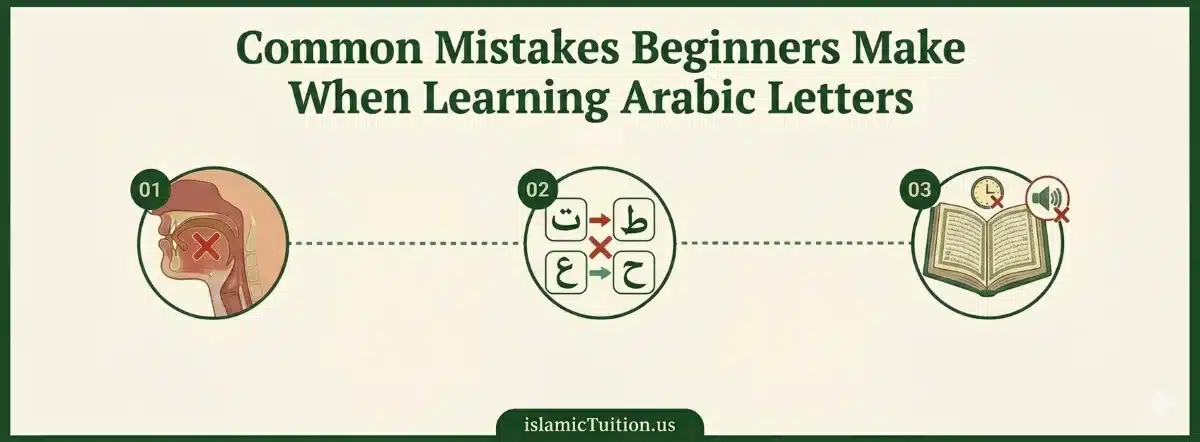
The Most Commonly Confused Arabic Letters
1. Taa (ت) and Tua (ط)
These two letters trip up almost every beginner. Both make a “T” sound to an English ear, which is why students initially treat them as the same letter. They are not.
Taa is a light letter pronounced with the tip of the tongue touching the roots of the upper front teeth. Tua is a heavy full-mouth letter pronounced deeper, with the tongue pressing further back and the mouth opening more fully. The difference is subtle to hear at first, but it becomes clear with practice.
In the colour-coded Tajweed Quran, Tua appears among the seven full-mouth letters, helping students visually identify which “T” requires a heavier pronunciation before they fully understand the rule behind it.
2. Haa (ح) and Kha (خ)
Both come from the throat area, which is why beginners often substitute one for the other. Haa is pronounced from the middle of the throat with a soft, breathy sound. Kha comes from the top of the throat with a rougher, more guttural sound, similar to the “ch” in the Scottish word “loch.”
For students who have never made a sound from that part of their throat before, both letters feel unfamiliar at first. The key is learning to feel where the sound originates, not just how it sounds from the outside.
3. Ain (ع) and Ghain (غ)
Ain is one of the most unique Arabic sounds in the entire alphabet. It comes from the middle of the throat with a constricted, almost squeezed quality. Ghain, by contrast, comes from the top of the throat with a gargling-like sound.
Neither sound exists in English, which is why beginners default to the nearest English equivalent, often a simple vowel sound or a soft “g.” Both substitutions are incorrect and produce a different letter entirely.
Why These Mistakes Happen
The core reason is Makhaarij, the articulation points of Arabic letters. Every Arabic letter has a precise point of origin in the mouth or throat. When a student does not know where a letter should come from physically, they produce the closest sound they already know from their native language.
For English-speaking students in the USA, this is particularly common with throat letters like Ain, Haa, Kha, and Ghain, because English has no equivalent sounds. The ear has never heard them produced correctly, and the mouth has never been trained to make them.
This is exactly why our tutors do not just say, “That is wrong, try again.” During class, the tutor shares their screen and shows visual Makhaarij diagrams, illustrations of the mouth and throat, indicating exactly where a specific letter originates. The student sees the physical source of the sound, hears the tutor demonstrate it, and then attempts it themselves. That combination of visual, auditory, and practical repetition is what builds the correct habit.
The Most Common Vowel Mistakes
Beyond individual letters, beginners frequently make two vowel-related errors:
Dragging a short vowel. Short vowels, Fatha, Kasra, and Damma, should be brief and crisp. Beginners who are reading slowly and carefully often hold them slightly longer than they should, which, in Tajweed terms, can change a short vowel into a Madd (elongated) sound.
Cutting a long vowel short. The opposite problem. Long vowel sounds produced by Alif, Waw, and Yaa as Madd letters should be stretched for two beats minimum. Beginners in a hurry to move to the next letter clip them short, losing the elongation entirely.
Both mistakes are easy to demonstrate and correct in a live session. The tutor reads the same word both ways, correctly and incorrectly, so the student can hear the difference before attempting it themselves.
Do Apps and YouTube Videos Cause More Mistakes?
Not significantly more than complete beginners. Students who learned some Arabic independently through apps or videos arrive with a mixed picture: some correct habits, some incorrect ones. The main issue is that no app corrects your specific pronunciation in real time. Errors go unnoticed and often become more embedded the longer a student practices independently.
A student who learned nothing is sometimes easier to work with than one who practiced incorrectly for months, because there are no habits to undo. That said, prior exposure is not a disadvantage if the student is open to correction.
Why Early Correction Matters
An uncorrected mistake in Arabic letter pronunciation does not stay harmless. Over time, it becomes the default. A student who reads Tua as Taa for six months will read it that way automatically, and correcting automatic habits takes significantly more effort than correcting a fresh mistake.
More importantly, in Salah, the recitation of Al-Fatiha and other Surahs with incorrect letter pronunciation can alter the meaning. The word Qalb, meaning heart, pronounced with a Kaaf instead of a Qaaf, becomes the word for dog. These are not minor differences; they are the reason scholars throughout Islamic history emphasised learning Arabic pronunciation from a qualified teacher rather than self-study alone.
Our Noorani Qaida course focuses on these exact letters from the earliest lessons. Every student reads aloud in every session, and every pronunciation error is corrected before moving forward. For students who are already reading the Quran but suspect they have embedded errors from early learning, our Quran recitation course includes a pronunciation assessment in the first session to identify and address those specific issues.
If letter-level accuracy and Tajweed rules are something you want to work on in depth, our Tajweed course covers Makhaarij systematically alongside all major recitation rules.
Frequently Asked Questions
The most reliable way is feedback from a qualified tutor in a live session. Recording yourself and comparing to a certified reciter like Sheikh Mishary Rashid Al-Afasy can also help identify obvious differences, but a tutor will catch errors that are subtle enough to miss on a recording.
Scholars differ on the specifics, but there is broad agreement that deliberately mispronouncing letters that change word meaning affects recitation. This is one of the primary Islamic reasons why learning to read with correct pronunciation from a teacher is strongly recommended rather than self-teaching.
Letters first, always. Tajweed rules are applied on top of correct letter pronunciation, not instead of it. A student who cannot yet distinguish Taa from Tua is not ready for Ghunnah rules. Get the foundation right, and the rules build naturally on top.